Treatment goal / Pigment
Pigment & Tattoo
Use target depth and colour to compare Q-switched laser with configurable light platforms.
Decision frame
Define the workflow before the equipment.
For a useful shortlist, compare 1064nm and 532nm Q-switched workflows separately from general filtered-light menu requirements. Target, diagnosis and operator competence come before price.
Shortlist questions
Four answers that improve a quotation.
- 01
Which target colours and depths are in scope?
- 02
Is a dedicated Q-switched platform required?
- 03
Which wavelength and spot controls need verification?
- 04
What consultation and operator workflow will the equipment support?
Decision guide
The short answer: separate tattoo, pigment and light-based work
Put a Q-switched 1064nm and 532nm Nd:YAG platform first when tattoo or defined pigment workflows are the central requirement. Put IPL or OPT into the comparison when the business wants a broader filtered-light menu. Do not combine those paths into one vague ‘pigment machine’ request. Target colour, depth, lesion identity and surrounding skin change the decision.
A Q-switched laser delivers short pulses at defined wavelengths. IPL delivers a range of wavelengths shaped by filters. Those mechanisms create different optical and operational choices. The machine still does not diagnose a lesion, identify an ink or predict a complete result. Your service must begin with qualified assessment and an explicit referral boundary.
Decision guide
Use wavelength as a question, not a promise
The archived Nd:YAG material documents 1064nm and frequency-doubled 532nm outputs. Different colours and depths interact differently with those wavelengths, while pigment in the epidermis remains part of the risk picture. That is why wavelength selection belongs to trained clinical judgment rather than a colour chart copied into advertising.
Published tattoo-removal literature reports variable response by ink colour, density, location, layering, treatment history and other factors. Multiple visits may be required, and complete clearance should not be guaranteed. When you write commercial projections, allow for consultation, photography, repeat assessment and aftercare rather than treating every appointment as identical.
Decision guide
Choose the platform around the dominant workload
A dedicated Q-switched platform offers a more focused optical workflow for a business built around tattoo and selected pigment work. Compare pulse characteristics, spot control, wavelength changeover, beam delivery, aiming, cooling, protective eyewear and service of the optical path. Ask how the operator confirms which optic or handpiece is active.
An IPL or OPT platform may support selected pigment and broader light-based services through filters and configurable pulses. That breadth adds responsibility. Verify every delivered filter, its identification, cooling, lamp or handpiece service life and the training attached to each application. An option shown in a catalogue is not necessarily included in the quoted unit.
Decision guide
Put diagnosis outside the sales funnel
Pigmented lesions can require medical diagnosis. If identity is uncertain or a lesion is changing, atypical or otherwise concerning, the equipment-sales page is not the next step. Build a referral route and make it easy for operators to stop. A list of possible applications must never be used as permission to treat an unknown lesion.
For tattoo work, consultation should record ink colours, layering, location, prior attempts, scarring and client expectations. For all optical work, screen skin type, recent tanning, medicines and relevant health history according to professional guidance and the current manual. Eye protection and controlled access to the treatment room are baseline workflow requirements.
Decision guide
Demonstrate changeover and maintenance
Ask for an unedited demonstration covering startup, wavelength or filter changeover, optic identification, spot adjustment, aiming, cooling, emergency stop, cleaning and shutdown. Watch whether the interface makes the active configuration clear. Ask what the operator does when output appears inconsistent and which checks require an engineer.
Optical components can be sensitive to contamination, alignment and handling. Confirm cleaning materials, expected wear parts, replacement lead time and the process for remote diagnosis. For IPL, add lamp or handpiece life and replacement pricing. For Q-switched equipment, ask about optical-path support and how the supplier verifies delivered energy during service.
Decision guide
Require an exact, documentable quotation
The quote should identify model, wavelengths or spectral range, filters, optics, spot controls, pulse controls, cooling, eyewear, accessories, electrical version, training, consumables and warranty. Ask for the current manual and the documents needed for your destination market. Compare line items rather than family names.
Older manuals and test records can explain the technology, but they cannot prove that a current Pmise configuration has the same parameters or market status. Match documents to the ordered model and named holder, and keep unsupported outcome or certification language out of your own marketing.
Procurement checklist
Questions to put in writing.
- Separate tattoo, diagnosed pigment and general light-service goals
- List dominant ink colours, client skin types and prior-treatment patterns
- Verify Q-switched wavelengths, optics, spot control and beam service
- Verify IPL filters, handpieces, cooling and replacement life
- Create diagnosis, referral, protection, consent and aftercare pathways
- Match current documentation and configuration to the purchase order
Candidate platforms
Open the product comparison.
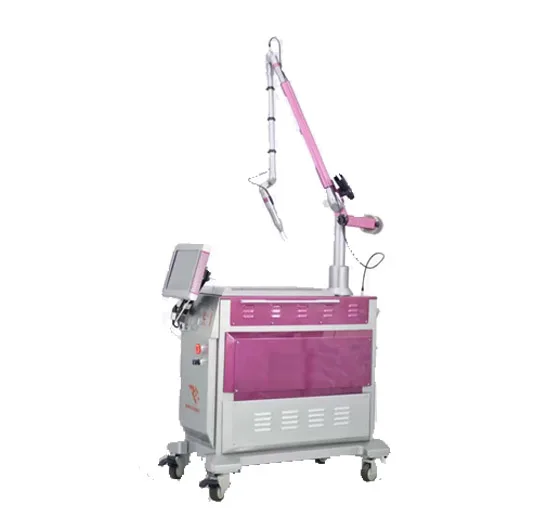
- Q-switched Nd:YAG — A dual-wavelength family documented for professional pigment and tattoo workflows.
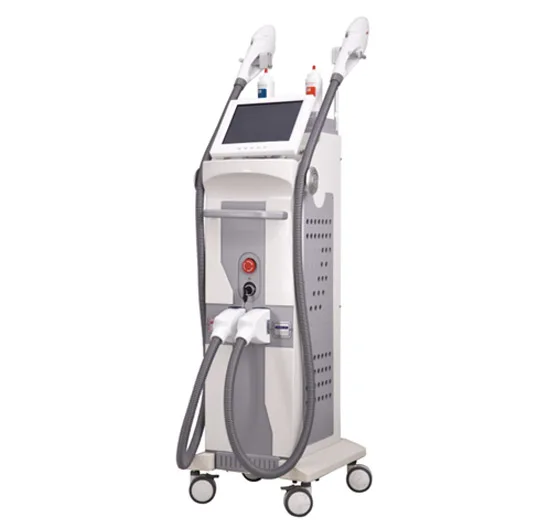
- OPT & IPL Platform — Configurable light-based platforms for buyers building a broader treatment menu.
Frequently asked questions
FAQWhy might a business need both 1064nm and 532nm?
They offer different absorption behaviour and are used for different target considerations. The operator must select them through qualified assessment and the delivered device guidance; neither is a universal pigment setting.
Can IPL replace a Q-switched laser for tattoo work?
They are different optical categories. A buyer focused on tattoos should begin with a dedicated, evidence-supported Q-switched comparison. IPL may belong in a wider light-service menu, not as an assumed equivalent.
Can the supplier tell us which lesions to treat?
Product training can explain documented use, but diagnosis and suitability belong to qualified professionals. Uncertain or suspicious lesions need referral, not a machine setting.
What should never be promised to tattoo clients?
Do not guarantee complete clearance or a fixed number of visits. Ink and client variables affect response, and follow-up should be based on observed progress and professional judgment.
Evidence trail
Published research behind the comparison
This guide is educational material for equipment selection. It is not medical advice, an operating protocol or a promise of clinical outcome.
Next step
Compare current configurations for a pigment & tattoo workflow.
Tell us your priority services, market, client mix and business type. Ask for the exact configuration, documents, training and service terms you need.
Describe your equipment plan ↘